Rough Theory

ACTIVE THEME

LINKS

COPYRIGHT

Creative Commons License
Unless otherwise noted, N.Pepperell's work is licensed under a Creative Commons License.

ACKNOWLEDGEMENTS

Wordpress.org

Get Firefox!

Archive for 'Blogging'

Where the Wild Things Are
Posted by N Pepperell, 1:19am 26/03/2008
Blogging, Procrastination, Writing

Cover art from Maurice Sendak's Where the Wild Things AreFor the next week, I will be away from Melbourne, off where the wild things are - although, as Thoreau tells us:

It is in vain to dream of a wildness distant from ourselves. There is none such. It is the bog in our brains and bowels, the primitive vigor of Nature in us, that inspires that dream. I shall never find in the wilds of Labrador any greater wildness than in some recess of Concord, i.e. than I import into it.

So perhaps it would be more accurate to say that I shall be transporting my own wild things with me, wherever I go. Wherever the wild things come from, the idea behind this trip is to domesticate a few tangled ideas and get them down on paper. I will be staying in what apparently was once a church, and is still a telephone-free environment - online access will be greatly restricted while I’m away. Commitments back in Melbourne mean that I won’t be completely out of reach - given that everything I’ve written over the past two years, formal or otherwise, has developed through the medium of the blog, this is probably a good thing - although I won’t be online long enough to watch any discussions here or elsewhere, I may still toss out the occasional post. Then again, I may not. Apologies in advance for any discussions I may leave hanging while I’m away.

Take care all…

Difference and Givenness
Posted by N Pepperell, 11:28am 21/03/2008
Blogging, Critical Theory, Events

Difference and GivennessI just wanted to mention that Sinthome from Larval Subjects has just posted an announcement that his much-awaited book Difference and Givenness: Deleuze’s Transcendental Empiricism and the Ontology of Immanence is being released and should be out in the world and available to read very soon. From the description at Northwestern University Press:

From one end of his philosophical work to the other, Gilles Deleuze consistently described his position as a transcendental empiricism. But just what is transcendental about Deleuze’s transcendental empiricism? And how does his position fit with the traditional empiricism articulated by Hume? In Difference and Givenness, Levi Bryant addresses these long-neglected questions so critical to an understanding of Deleuze’s thinking. Through a close examination of Deleuze’s independent work–focusing especially on Difference and Repetition–as well as his engagement with thinkers such as Kant, Maimon, Bergson, and Simondon, Bryant sets out to unearth Deleuze’s transcendental empiricism and to show how it differs from transcendental idealism, absolute idealism, and traditional empiricism.

What emerges from these efforts is a metaphysics that strives to articulate the conditions for real existence, capable of accounting for the individual itself without falling into conceptual or essentialist abstraction. In Bryant’s analysis, Deleuze’s metaphysics articulates an account of being as process or creative individuation based on difference, as well as a challenging critique–and explanation–of essentialist substance ontologies. A clear and powerful discussion of how Deleuze’s project relates to two of the most influential strains in the history of philosophy, this book will prove essential to anyone seeking to understand Deleuze’s thought and its specific contribution to metaphysics and epistemology.

Metonymy
Posted by N Pepperell, 11:08pm 15/03/2008
Blogging, Professional Life

Georges de la Tour MagdaleneThe sorts of conversations that have been possible on this blog, and on the other places I’ve stumbled across since starting this site, have been more important to me than I can easily express. Online interactions can be difficult to navigate - misinterpretations are easier, conflicts can escalate more quickly, discussions can spiral in more negative directions, than similar face-to-face interactions. I’ve been active in online discussions of various sorts since back in bulletin board days, and so I have a fair sense of what can go wrong.

When I realised people were actually reading this blog, that conversations would be possible about my work here and at other sites, I wanted to see whether it were possible to incubate different sorts of interactions than I had had in the past - interactions where contention and debate could take place without the sometimes ugly spirals that can characterise online discussions. And I also wanted to escape some of the constraints of face-to-face discussions, to feel free to extend myself intellectually in ways that often aren’t possible in traditional institutional settings, to make an advantage out of some of the depersonalising elements of online discussion, in order to have conversations that can explore ideas in a way that separates those ideas more from the person who puts them forward, than is generally possible in face-to-face interaction. None of this is some sort of ideal of communication - I don’t think communication “ought” to be so abstracted from the personal - but it was the specific form of communication I was seeking out here, as a form of interaction less available - for me - in face-to-face settings.

I’ve discussed in earlier posts the reasons that, initially, I posted pseudonymously here and why, even when I decided to “out” my identity, I still didn’t use my first name, even though it was easy at that point for anyone to look it up: previous experience in online discussions had shown very clearly how quickly things could go in very ugly gendered directions - I wanted at least the buffer provided by gender not being immediately evident to drive-by visitors to the blog. To the extent this is ever possible, I hoped people might deal with my ideas, and not with “me”, unless we were having a discussion where something about my personal background was relevant. Again, I’m not stating an ideal here - not suggesting that this is what discussions “ought” to be, or that it’s inherently better to differentiate ideas from their bearers, or anything like that. I’m just describing what I see as a very personal motive for seeking out a very specific kind of interaction that is difficult to find elsewhere, where for a period I can worry much less about gendered interpersonal dynamics than I often can in everyday life.

Gender issues aside, I also made a decision, which perhaps I follow through on better at some points than others, to try not to take offence at the things people say or the way positions are articulated - to try to find the best point I can see, in whatever position I’m addressing, and respond to that. This doesn’t prevent miscommunication. Sometimes the best point I can see, still isn’t what the other person meant - sometimes other people are offended by what I intend to be a positive restatement of what I take them to be saying - things still go wrong. Generally, though, on balance, and with most people who have landed here, I hope I’ve been largely successful at communicating that I’m interested in taking other people seriously, in de-escalating and redirecting conversations that seem in danger of getting a bit heated, in having largely productive discussions, where it becomes possible - for me at least - to learn something from them. It’s what I’m looking for from blogging, and largely it’s what I’ve managed to find here.

Sometimes it fails spectacularly. One recent interaction - I won’t link to it, but have screenshotted it, blanking out the other person’s photo and identifying details. I stumbled across a blog referring to an event in which I participated recently. The post plugged the event, and then quoted some text from my blog, made fun of the complexity of my writing, and then asked a question about what I was trying to say. Part of what I mean, when I talk about trying to respond to the best point I can find in something, is that in general I seriously don’t take criticisms personally, even when they are voiced disrespectfully - and, if I’m going to respond, I address my comments to the substantive points raised, and generally aim for discussion, rather than for self-defence. So I responded; and the reply then consisted of this blogger’s description of the kind of sex he fantasised having with me (if folks care about this sort of thing in deciding whether to click through, it’s not a subtle comment).

My main reaction to this is a feeling of tired familiarity at how often exactly this sort of thing used to happen when I posted in discussions where my gender was more evident than it is here. There are some other complicating factors, which I won’t go into here, which make this incident less removed from my real world life than I would like. I don’t know what sort of discussion I’m looking to open, by posting about this… Incidents like this are depressing, in what they show about the ready-to-handness of this kind of behaviour. But I think what is striking me about this incident, is the way it reinforces something I’ve been feeling about publishing (as, of course, we all need to do) in settings other than the blog. Although this guy quoted some material from the blog, he knows my name - and therefore gender - from the conference program, where, along with all the other presenters, I spelled the name out in full. Every time I have provided details for a conference program or other material I knew would end up online, I’ve felt very conflicted over doing this, because it means that my full name now circulates, immediately gendering my work - taking away the possibility of the less pronouncedly gendered interactions that I’ve been able to cultivate online. I think I’ve been telling myself, as I hand over what should be this least personal of personal details, that I am being ridiculous - that I’m experiencing something as a loss, when nothing is really taken away. I think this incident stands out for me as an indication that I wasn’t entirely wrong - that something has been lost, and that a further level of anonymity - at least to casual readers - has been taken away.

The thing is, the way I’ve carved out a space here is, I know, a very apolitical response to a political problem - I’ve opened a level of freedom for myself by creating a small space of personal ambiguity, which has meant that it’s generally only the folks who stick around, who have some curiosity and interest in what I’m writing, who know much about me personally. This strategy doesn’t hit at the fundamentally political issue of how knowledge of the personal is wielded. So there’s a sense in which this sort of temporary shelter I’ve erected here has perhaps never been appropriate. But it has been more important to me than I can adequately explain to be able, for a time, in one part of my life, not to need to worry about such things…

We’ll see if I keep this post up :-) I’m not sure yet whether I’ll think better of it and take it down…

Great(er) Scott!
Posted by N Pepperell, 4:16pm 01/03/2008
Blogging, Procrastination

So it’s finally happened. Prompted by an email asking him to identify his secret blog, Scott Eric Kaufman has just outed himself as the hitherto faux-donymous author of what in the hell…:

My real name is Scott Eric Kaufman. I have a public blog that you may have read. You may ask yourself, why is the public blog so much better written than the pseudonymous blog? The answer is that I never intended this blog for public consumption. An email I received prompted some soul-searching, after which I feel it is unethical to continue this charade.

The depths of Scott’s deception - the intensity of his betrayal of those of us who have interacted with him over the years as both “himself” and as his alter ego “Nate” - can perhaps best be illustrated by the extent Scott took to conceal this identity, when my own identity was called into question some months back. As “Scott”, Scott wrote:

One student insists N. Pepperell’s fictional, and I’m inclined to agree. No actual person could write that much that quickly and remain sane.

As “Nate”, however:

I’m under the impression we have an implied contract for mutual belief, which obligates me to affirm the proposition “N. Pepperell is a real person” and to not have truck with any speculation to the contrary.

So which is it… “Scott”? Which is it?

Reflections on Elson’s “Value Theory of Labour”, part 1

So, by popular demand, a follow up to the book-meme post, where I responded to Nate’s tag with a few sentences from Diane Elson’s “The Value Theory of Labour” from her edited volume (1979) Value: The Representation of Labour in Capitalism. This post wasn’t the first time someone has asked me to talk about my work in relation to Elson’s, so I promised to follow up on the short meme post with something longer soon. This is that something longer… ;-P

Before I get into Elson, I should mention the progress of the meme over at Now-Times - where my tag forced poor Alexei to have to translate a text in German, which also contained selections from Greek - I suppose, like all viruses, this one hits some people harder than others… Over at Grundlegung, Tom responded to the meme, but then rudely placed himself in quarantine and refused to share and share alike. I have patiently tried to explain that Tom has undertaken the commitment to infect others when he undertook the commitment to acknowledge the tag, but Tom, as always, stubbornly resists the implications of Brandom’s queen’s shilling argument. Tom: I have updated your score accordingly. Praxisblog promises “an appallingly long and obsessive response to that damn book meme”. I think I am afraid. The meme has hit massthink whilst Ryan/Aless is travelling - I’m certain we can all understand how inconvenient that is - he’ll respond in a more settled moment. I didn’t tag Gabriel Gottlieb over at Self and World, but the bug got to him anyway, and I’ll link his response here because I am still groaning from his title: “On the Very Idea of an Internet Meme”. Andrew over at Union Street tried to tag me, only to realise I’ve already been bitten - if you like, Andrew, you can consider this post a relapse, and consider that your second tag made me come down with a much worse case of this thing, forcing me to engage more deeply with the text than just quoting a few sentences…

Okay. Diane Elson. Note that I’m likely just to post notes on Elson’s piece here, rather than provide a worked out argument about how our positions intersect - since a few other folks hovering around have also read her, there should be some possibility for correcting anything I get too terribly wrong here…

Elson’s piece starts with an excellent question: what is Marx’s theory of value a theory of? The answer to this question is far from obvious, and major differences of interpretation of Marx’s work pivot on the issue.

Elson begins by outlining two common interpretations of the labour theory of value:

(1) The theory of value allows Marx to prove the existence of exploitation.

Elson associates this position with a transhistorical conception of the category of value - a conception that holds that surplus in all societies is based on value, but that in capitalism this is concealed - hence the need for a theory to reveal value (and human labour) as the basis for the surplus. Elson argues that Marx does not appear to have regarded value as a transhistorical category, and also that Marx’s concern was not to demonstrate that exploitation exists under capitalism, but rather to analyse the form of exploitation specific to capitalism. She argues, however, that this approach does at least keep the political charge of Marx’s theory at the forefront. (115-116)

(2) The theory of value allows Marx to explain prices.

Elson associates this approach with attempts to see Marx as a sort of critical culmination of classical political economy, proposing a theory with a similar object to that of Smith, Ricardo or Mill, which provides an explanation of equilibrium prices in a capitalist economy. Elson notes the (tacit or explicit) depoliticisation of the theory entailed by this reading - and also notes a tendency to hold the question of the determination of equilibrium prices to be so central that the category of value has come to be rejected, as arguments have been put forward that for why this category is inadequate to account for prices. (116-121)

She then opens a third possibility: that the object of the concept of value was never to theorise price - or, indeed, to account for “the origin or cause of anything” (121). She suggests that Marx’s concept of “determination” has been flattened into a notion of “cause” or “origin” in a way quite alien to Marx’s use of the term. (I agree with Elson on this - “determination” is one of a number of concepts that picks up very different analytical valences when lifted out of its Hegelian context and translated into the terrain of the applied social sciences - to the detriment of Marx’s analysis.) She therefore turns to an analysis of the object of Marx’s theory and the method of Marx’s analysis, as a necessary precursor to teasing out Marx’s relationship to Ricardo and to the questions that preoccupied classical political economy. (122-123)

Elson argues that the object of Marx’s theory was not the phenomena of exchange, but rather labour. In her words:

It is not a matter of seeking an explanation of why prices are what they are and finding it in labour. But rather of seeking an understanding of why labour takes the forms it does, and what the political consequences are. (123)

This analysis of the form of labour, moreover, is concerned with more than simply how labour is distributed within capitalism - a question that, for Elson, points back to the more traditional understanding of the labour theory of value. (124-128) It also points beyond the analysis of what Elson calls the “structure of production” - a concept Elson regards as too “deterministic” in a causal sense. (128-129) In Elson’s own words:

As several authors pointed out, Marx’s concept of determination is not ‘deterministic’… Although Marx stresses that determination can never be simply an exercise of individual wills, he also stresses that it is not independent of and completely exterior to the actions of individuals….

Distribution of social labour is not an adequate metaphor for this process of determination, because such determination always begins from some pre-given, fixed, determinate structure, which is placed outside the process of social determination. What is required is a conceptualisation of a process of social determination that proceeds from the indeterminate to the determinate; from the potential to the actual; from the formless to the formed. Capital is an attempt to provide just that. (129-130)

Elson notes that Marx’s formulations of this problematic, particularly prior to Capital, are often confusing and inconsistent - in part, she argues, because he was wrestling this problematic out of political economic texts that were concerned with something closer to a “labour theory of value”. Elson therefore centres her analysis on Capital, where she believes the object and method that are specific to Marx’s work are developed more clearly. (130)

Elson next offers the interesting suggestion that the readings of value theory she has already discussed are all guilty of what she calls a “misplaced concreteness” - a tendency to posit that certain “independent” variables are somehow already “given” in the process of production, while understanding the problem to be how to determine, based on those givens, certain other, “dependent” variables in the process of circulation. She argues:

It is simply taken for granted that any theory requires separable determining factors, discretely distinct from what they are supposed to determine….

This approach poses the relation of determination as an effect of some already given, discretely distinct elements or factors on some other, quite separate, element or factors, whose general form is given, but whose position within a possible range is not, using what Georges-cu-Roegen calls ‘arithmomorphic concepts’. Essentially a rationalist method, it assumes that the phenomena of the material world are like the symbols of arithmetic and formal logic, separate and self-bounded and relate to each other in the same way. This is not Marx’s method; his theory of value is not constructed on rationalist lines. (131)

“Arithmomorphic concepts” may become my new favourite term. I agree with Elson on this - I’ve been drawing attention to a similar problem by tugging on the issue of what Marx means when he calls Capital a “scientific” work - a phrase that is often misinterpreted in analogous ways to the concept of “determination” that Elson focusses on here. Just as Marx’s “science” is not an instrumental or positivist exercise, but an exercise in reconstructing a network of relationally-determined concepts, his notion of “determination” is intended to situate his categories within the network of relationships within which they acquire their present-day meaning: the concept of “determination” operative in his work is not a causal concept in an applied social science sense of the term.

Back to Elson: She argues that this presupposition - of givens strictly separated from dependent variables - operates even in some apparently unlikely places, such as in Althusser’s concept of “structural causality”, and in approaches that break with concepts of structure, only to try to recover “conditions of existence” purported to lie behind structure. (131) She then uses Ollman, as well as her own examination of Marx’s chemical metaphors and his complex discussion of the relationship between value, exchange-value, and labour time, to illustrate the ways in which Marx’s categories include within themselves aspects of the reality they are described as “determining” - undermining an interpretation that would see them in terms of independent-dependent variable relationships. (132-135)

She uses this analysis to argue that Capital, while viewing labour-time and price as distinct, does not understand the relationship between the two as that of an independent to a dependent variable. Elson argues:

The social necessity of labour in a capitalist economy cannot be determined independent of the price form: hence values cannot be calculated or observed independently of prices. (136)

Thinking back for a moment to the argument I’ve been making on the blog and in the thesis about Marx’s appropriation of Hegel: one of the things I’ve suggested that Marx draws from Hegel, is a peculiar argument about the relation of “essence” and “appearance”. Hegel criticises approaches that separate essence and appearance into two separate substances or worlds, and then try to answer the question of how these separate substances are related to one another. Essence and appearance are intrinsically related, for Hegel: they are mutually interpenetrating, mutually generative, sharing the same substance, but also distinct from one another. Marx takes this sort of argument over into Capital, with value presented as a kind of “social essence” generated in and through the flux and apparent lawlessness of the appearance of exchange (the argument is a bit more complex than this, as exchange isn’t the only site of “flux” - I’ll leave this point aside for now). In Marx’s argument, this social “essence” does not exist as some separate substance that sits outside exchange, determining the movement of “appearances” in the form of prices. Instead, value is something that emerges in and through that flux - a pattern or regularity that the flux itself generates, in and through its apparent random walk. Within this framework, it doesn’t make sense to talk about “value” as if it exerts a casual force on exchange as the dependent variable. Value is rather itself an “effect”, a “result”, intrinsically bound together with the flux through which it becomes manifest as a non-random pattern emergent over time. This pattern “determines” the flux, not in a casual sense, but as a description of the qualitative attributes of one of the aspects of, in this case, an overarching process in which both the “law” of value and the “flux” of exchange are moments.

I’m not suggesting here that Elson is making exactly the same argument, or would agree with how I’m am (somewhat clumsily) expressing the point here - I’m just trying to link her argument back to the ways I’ve expressed similar points recently on the blog. Elson, for her part, goes on from the quote above into a (to be honest, somewhat confusing to me - but that’s probably because I’m used to making this argument via Hegel’s essence/appearance distinction) discussion of “immanent measures”. Her point is to draw attention to what I usually call the “counterfactual” dimension of value-determining labour: the fact that this labour bears no relationship to empirically-observable inputs of labour time in production. She uses this to segue into an argument that money, not labour-time, serves as the social standard of measurement - and that labour-time and money are not understood as discrete variables whose proportional relationship to one another must be discovered, but rather as different forms assumed by a continuous a social process. (136-139)

Elson next asks whether she has perhaps demonstrated that Marx’s argument is incoherent, circular, or serves no purpose. If the argument can’t explain causation or origin in terms of necessary and sufficient conditions, what possible purpose could the argument serve? (139)

To address this question, she moves to an argument about dialectical materialism - about Marx’s theory as theory of immanent historical transformation through which social forms dissolve themselves and change into new forms, via internal social dynamics with no external cause. In Elson’s read, this approach does not involve making an argument about how earlier social forms led to later ones: even if the raw materials for a later social form derive from an earlier form, it is not this story of historical origin that is important for grasping a social form - this would entail adopting a standpoint outside a social form, to grasp that social form - an approach that Elson argues falls back into the independent-dependent variable trap. Instead, social forms must be understood with reference to their own immanent logic - and uncovering how that logic suspends within itself contradictory moments or potentials that determine that social form as transient and transformable. (139-142)

Elson argues that it is these contradictory moments that Marx describes as “determinants” - and that this description does not imply that the “determinant” somehow sits outside the social form, causing that social form to unfold in a particular way. Instead, “determinants” are moments of a complex social form, isolated out in Marx’s analysis and considered in abstraction from one another, in order better to draw attention to the conflictual potentials embodied in the society as a whole. The analysis does not stop with this process of isolation and abstraction, but then moves on to resubmerge the isolated moments back into the social process, which we can now grasp differently, as a unity that presupposes all the conflictual moments that have been analysed in isolation. Elson’s description here again echoes points I have been making through my analysis of Hegel’s influence on Marx:

These different, counter-posed aspects are often referred to be Marx as ‘determinants’ or ‘determinations’ (just as the opposed movements whose resultant is the ellipse are referred to as ‘determinants’). But that does not mean that the form is produced or caused by the ‘determination’ or ‘determinants’ acting in some autonomous way… The point is that the determinants are not independent variables, but are simply aspects, one-sided abstractions singled out as a way of analysing the form.

The analysis of a form into its determinants is, however, only the first phase of the investigation. After this phase of individuation of a moment from the historical process, and dissection of the tendencies or aspects counterposed in it, comes the phase of synthesis, of reconstitution of the appearance of the form, and of re-immersing it in process… This second phase does not simply take us back where we began, but beyond it, because it enables us to understand our starting point in a different light, as predicated on other aspects of a continuous material process. It suggests new abstractions which need to be made from a different angle, in order to capture more of the process. The phase of synthesis brings us back to continuities which the phase of analysis has deliberately severed. The whole method moves in an ever-widening spiral, taking account of more and more aspects of the historical process from which the starting point was individuated and detached. (142-143)

This is a very nice description of Marx’s method in Capital. From my point of view, it omits some details that begin to explain the order in which Marx introduces this categories - but this is a sort of trivial point to make, in response to a brief discussion that has other argumentative targets in view. I like very much the way Elson emphasises Marx’s practice of taking something that presents itself as a unified object, and then breaking that object into aspects, and teasing out the often conflictual dimensions of each aspect - this point is quite central to how I read Marx. I’m less happy with the characterisation of this method in terms of a back-and-forth movement from analysis to synthesis, although these are terms that Marx himself occasionally uses in discussion of his work, and my unease is more a matter of concern that these terms - much like “determination” - have more common associations that don’t quite capture what Marx does. I like the way that Elson emphasises how Marx’s method makes it possible to transform our understanding of categories - although I would like to supplement this with a discussion of how the categories are then introduced based on the order required to tease out the relationships that connect them to one another, to reveal how categories presuppose one another, would also open up an argument about how our understanding of earlier categories comes to be transformed, not simply by Marx’s analysis of the moments of those categories, but by the unfolding of the later categories as well. Again, though, I don’t understand this as something required for what Elson is trying to achieve in this article.

Elson concludes this pivotal section by asking what form of knowledge we acquire through this method. Her answer:

It cannot give a Cartesian Absolute Knowledge of the world, its status as true knowledge validated by some epistemological principle. Rather it is based upon a rejection of that aspiration as a form of idealism…. It is taken for granted, in this method, that the world has a material existence outside our attempts to understand it; and that any category we use to cut up the continuum of the material world can only capture a partial knowledge, a particular aspect seen from a certain vantage point. (143)

Elson uses this point to argue that world cannot be appropriated fully in thought; she suggests, however, that it could perhaps be fully appropriated in practice (143) - a position I’m not sure Marx would share, as practice also has its situatedness, its form: I’m not sure that appropriation of the world can be “completed”, whether in thought or in practice… She then moves to a criticism specifically of “capital logic” approaches, on the grounds that such approaches confuse capital - which she takes to be a category of analysis - with an entity, existent in the world in some form. She argues that this move falls into an:

illusion, taking capital not as a one-sided abstraction, a category of analysis, but as an entity; and understanding the historical process of form determination as the product of the self-development of this entity. (144)

My reaction to this comment depends on what Elson means by certain key terms. As phrased, this comment strangely sounds to me a bit like a reintroduction of a sort of essence/appearance distinction of which Elson is critical in other moments of her account: the comment seems to position our “thoughts” about an object, as subsisting outside that object - and also to position our thoughts as, in Hegelian terms, “inessential” in relation to their object, which is constructed as separate from themselves. I take Marx instead to be making a practice-theoretic argument about the generation of categories of thought - such that what we “think” is what, in some dimension of social practice, we “do”. I take his arguments about value, abstract labour, capital, and similar “supersensible” categories to be Durkheimian - to be arguments that we are enacting such things as social entities by behaving as though such entities exist in our collective practice. This doesn’t mean that such entities exist somehow outside our practice, “determining” that practice in a causal sense - and I take it that it is this move of which Elson is critical, as this sort of move is both idealist and tends to be undermining of attempts to conceptualise agency. I understand the concern motivating her critical comments here. As expressed, however, these comments treat capital as more “illusory” than I think Marx takes it to be: capital is something we do, something we create - and also something we can undo, something we don’t need to create. It is a social - not solely a conceptual - reality in the present time; it needn’t be either a social or conceptual reality in the future.

I’m only about halfway through Elson’s chapter at this point - from here, having laid a solid foundation, Elson jumps into the textual and argumentative specifics of her reading of the labour theory of value. I think I’ll pause here for tonight - it’s getting late, and I have an early start tomorrow. Hopefully I can find time to comment on the remainder of the piece soon. [Note: part two here.]

Cold Reading
Posted by N Pepperell, 10:22am 20/02/2008
Blogging, Procrastination

So Nate has tagged me for a meme on a day when I am feeling flat and uninspired - and, amusingly, the meme sends me to an article I’ve been meaning to re-read for the longest time - it’s like the universe is conspiring against my procrastination. Next to me on the desk is Diane Elson’s “The Value Theory of Labour”, from Value: The Representation of Labour in Capitalism (1979, CSE Books, ed. Elson). The meme commands:

1. Pick up the nearest book (of at least 123 pages).
2. Open the book to page 123.
3. Find the fifth sentence.
4. Post the next three sentences.
5. Tag five people.

There is some slight ambiguity over what constitutes the fifth sentence - do I count the fragment spilling over from the previous page? I’ll start with the first whole sentence… The three sentences (in some ways less interesting than the previous ones) are:

This does not mean that Marx was not concerned with price, nor its relation to the magnitude of value, but that the phenomena of exchange are not the object of the theory. (Again this is not a completely new thought, see Hussain, this volume, p. 84.) My argument is that the object of Marx’s theory of value was labour.

I really should take this opportunity to discuss what Elson means here, and the relationship between my position and hers. But I haven’t had coffee yet - and have a pile of Badiou to read today (note that, in spite of this, somehow Being and Event didn’t manage to be the book closest to me when I read Nate’s request… ;-P). So Badiou is coming with me for coffee, and I’ll have to write on Elson some other time…

But now I’m meant to tag people… My least favourite part of all memes… ;-P How about I pick on Tom, Ryan/Aless (by the way R/A, I’ve been meaning for ages to reply to your post on Ideology, and still intend to do so - I’ve just been caught up in other obligations), Alexei, L Magee (from whom I’m really wanting a promised post on the concept of sublation, but maybe this will get things started… ;-P), and Praxis.

Before the Science
Posted by N Pepperell, 1:41am 04/01/2008
Blogging, Critical Theory, Reading Group

On New Year’s Eve, I rudely jumped forward to discuss the section on “With What Must the Science Begin?” from Hegel’s Logic of Science. The first in-person reading group meeting on this work will take place Thursday the 10th, and will discuss that section - but also the Prefaces and Introduction. This suggests that perhaps a bit of backstepping is in order. Hopefully I (or someone else? someone currently writing on the history of logic, perhaps?) will write something on the Prefaces and Introduction before the in-person group actually meets.

For the moment, just an organisational note: as with last year’s discussion of Phenomenology of Spirit, this year’s reading group will spill over online. The parallell online discussion opens things out to a wider range of perspectives - and also makes it possible for people who miss sessions due to other commitments, to catch up and participate in other ways.

As with last year, the parallell online discussion may not lead to posts on all sections. Posts also won’t necessarily aim to move through sections in any step-by-step way, and they may or may not have an overarching argumentative “point”: this will depend on the interests and time of whoever writes them. Last year, we had a bit of everything, from jokes (including some very bad ones), to comments on isolated fragments of text, to duelling interpretations of pivotal sections, to more systematic readings. I wouldn’t expect contributions to be any narrower in format, interest and tone this time around.

Posts from me and, perhaps, other participants in the in-person group will go up here as the in-person discussion moves through the text. Mikhail Emelianov from Perverse Egalitarianism has hinted that he might allow himself to be strongarmed into contributing something on selected sections over there. If others who have blogs are perhaps interested in doing something similar, let me know - or just chime in and include a link back here, and I’ll post a pointer to the discussion at your blog. If I’m the only or the main person posting, chances are good that, as with last year’s discussion of Phenomenology of Spirit, you’ll still be seeing posts on the first third of the text, a year after the in-person reading group took place… Not that there’s anything wrong with that… ;-P But not having to wait on my idiosyncratic writing schedule - particularly during what will be a very intensive writing year for me - has its advantages.

As long as I’m organising: I’ve been meaning to collect into one place a list of all the posts generated (at whatever delay) by the Phenomenology of Spirit reading group last year. This seems as good a place as any to tuck them away below the fold…

Blogging Cheers and Fears
Posted by N Pepperell, 2:42pm 26/12/2007
Blogging, Links

Joseph Kugelmass has posted his reflections on the best and worst of intellectual blogs from this past year over at The Valve and The Kugelmass Episodes. Rough Theory gets a nod for its revamped appearance and for the recent illustrated reflections on Hegel’s Phenomenology. Since those reflections pertained to Hegel’s argument that essence arises from appearance, I’ll conclude that this is a recognition of the high quaility of the content, in the guise of recognising the form… ;-P

Among the blogs Joe recognises on the positive side of the spectrum, he draws special attention to a number of newer blogs, including Alexei’s Now-Times, Wildly Parenthetical, and the folks over at Perverse Egalitarianism.

On the more negative side, Joe worries about a certain ebbing of more intense debate as the year has gone on, and is critical of what he sees as a growing concern to mobilise blogging for career purposes, of parodies in search of a punch line, and of posts with many sequels (not sure I’ve seen any of those), which Joe regards as an abjuration of the ideal that “each piece must be its own revolution”.

Joe’s wish for the coming year:

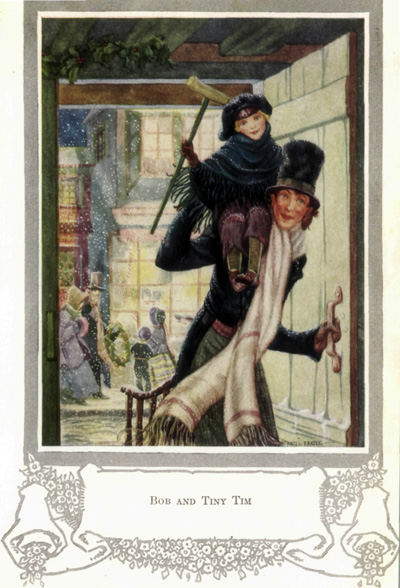
Tiny Tim on Bob's shouldersSo, what’s ahead for 2008? I can’t predict trends, but I can say what I hope for, and that’s a renaissance of words in their essential loneliness. Intellectual blogging is a medium that thrives because it captures the quietude of those moments when we seal ourselves off from our surroundings in order to consider the printed words of another person. The tremulousness of the word, the expectation of an answer, the abjection and shamelessness of writing for self-publication: in order to be honest, a blogger has to be vulnerable, more so even than the author of a book. What she is writing apparently had to be blogged to be written at all. Given the voluntarism of the blogosphere, polish is merely comic; risk is the only thing worth admiring. The risk of saying too much, the risk of being unread, the risk of being misread—intellectual blogging must change from an indifferent exercise of dignified exposition into the willing practice of risk.
Do I Read Books…
Posted by N Pepperell, 9:36am 21/11/2007
Blogging, Professional Life, Reading

I had a conversation yesterday with a senior colleague who has long been sceptical about blogging as a medium - which is fair enough: there are limitations, and there is no particular reason for everyone to find blogging, or reading blogs, a useful activity - for either professional or leisure purposes. From prior conversations, he has some idea how and why I use the blog to develop my own concepts, but yesterday was curious how I keep track of other blogs - how I decide which ones to read, how I know when they’ve been updated, and why this sort of reading might be useful as more than a leisure activity, etc. With a bit of difficulty, as it’s not the easiest thing to describe to someone who’s never seen this at work, I talked about RSS and different kinds of readers and tracking services, and about the process of discovering blogs relevant for particular interests.

He then had some questions about how much time it takes to keep track of the blogs I follow, and I explained that there is really only a very small number of blogs that I read, so to speak, “cover to cover”. The rest of the blogs I track are more ways of managing my own strange interdisciplinary interests - keeping rough track of good blogs in a wide range of fields makes it at least reasonably likely that I’ll hear about important new work and trending research themes, in a way that can otherwise be difficult for a non-specialist. When I read blogs for this purpose, I may not read them closely or participate in the discussion, but will often skim entries quickly in order to jot down key authors or titles, so that I can follow up on them later.

For some reason - and I find that things like this often happen when I try to discuss how I use blogging as a professional tool - this then led to the statement - apparently serious: “So… you don’t read books now any more? Blogs have replaced that?” (Evidently, he hasn’t looked into my office, or seen me wandering down the hallway, lately…) I don’t mind this kind of question, but I always find it odd - the implied notion that there is an either/or involved - that I would either use electronic media, or read books - that the committed use of a particular technology necessarily means a devaluation of other technologies… The reality is much more mundane: my major everyday professional purpose for reading blogs is to help me discover and prioritise conventional books and journal articles to read…

Of course, this kind of mining of blogs for information doesn’t account for the bulk of the time I might spend reading other blogs - the smaller number of blogs I read closely, because they are working on similar themes or because I just enjoy the author’s interests and expression, are where most of my attention goes when I have time to read online.

But I still somehow manage to find time to read the odd book here and there, as well… ;-P

Inaccessibility
Posted by N Pepperell, 1:35pm 10/11/2007
Blogging, Procrastination

Not much writing going on around these parts lately - sorry about that. Final grades are due on Monday, I’ve been in conference preparation mode - and, of course, I have the traditional end-of-term cold… Hopefully I’ll get through all this, and back to normal posting soon. In the interim, readers can perhaps enjoy this, which a certain someone saw fit to email me - it purports to determine the level of education required to read a blog:

Regular readers may thus have something on which to congratulate themselves (and a certain blog author may need to work a bit harder on developing a clearer writing style…).